Be Patient with the Current
How listening to the body became my way through pain, overwhelm, and collective uncertainty

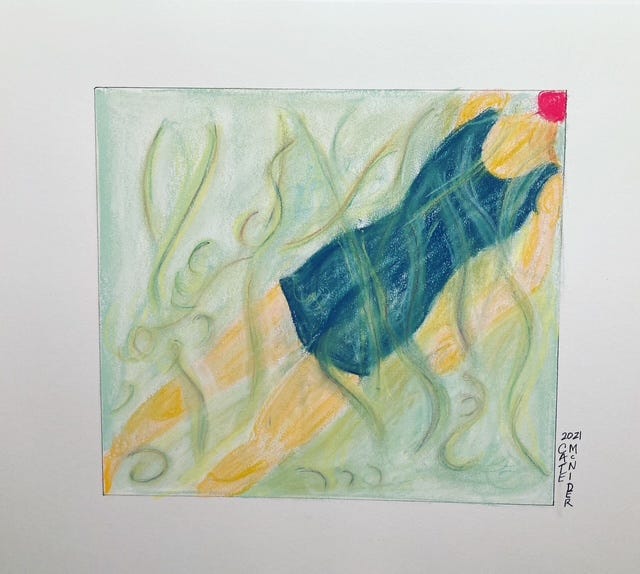
An ocean swimmer once told me about swimming all the way around Bermuda. What stayed with her wasn’t the distance or the danger, but a simple truth she learned along the way: you have to be patient with the current. Fighting it only exhausts you. Learning how to move with it—without losing direction—is what keeps you going.
We are living in a state of near-constant acceleration. News breaks endlessly. Images of crisis, conflict, and uncertainty arrive faster than the nervous system can process them. Our bodies—designed for rhythm, rest, and relationship—are being asked to function inside an always-on culture. Overwhelm has become normalized. Anxiety hums beneath the surface of daily life. We’ve never been here before—individually or collectively—and patience with ourselves may be one of the most necessary wellness practices of this moment.
The question many people are quietly asking isn’t abstract. It’s physiological: How do I stay open, grounded, and myself while everything feels unstable?
For me, that question arrived early, and it arrived through my body.
I was diagnosed with scoliosis as a teenager. Long before I had language for trauma, embodiment, or nervous system health, my body was naturally negotiating imbalance and tension. Pain wasn’t always present, but effort was. Growing up required vigilance, and over time that vigilance became a way of living—physically, emotionally, and psychologically.
I lived in a body that was always working, always bracing, without realizing how much energy that was costing me. As the years passed, the strain accumulated and manifested in a distorting spine. What I didn’t yet see was that the patterns I was living inside—tension, hyper-responsibility, constant self-monitoring—were not just personal. They were reinforced by a culture that rewards compliance over awareness, and productivity over presence and authenticity.
My turn toward healing work at thirty, wasn’t aspirational; it was practical. It was imperative to uncover the source of the tension, and the emotional tentacles that blocked my energy from flowing freely. Unlearning chronic tension took time—decades, really. There was an iceberg beneath the surface, made of physical holding intertwined with emotional and psychological patterns. But as those patterns gradually softened, and released something unexpected happened: choice expanded — I was recovering access to myself.
That exploration took me through adding many somatic certifications, which eventually led me to the Alexander Technique, a psycho-physical discipline focused on awareness, habit, and nervous system re-organization. Training to become a teacher offered three intensive years of experiential learning and undoing — an education in how deeply the body holds and expresses a pattern, and how change actually happens.
Sitting in a room with ten people actively listening to what someone was saying was revolutionary to me, and it reset my nervous system every day I was in class. What I learned was both simple and radical: the body does not respond to force. It responds to listening, awareness and directing it to do what I want, thereby disturbing and overwriting the habit and the pattern.
This accumulation of experience and understanding became the foundation of my work, doing business as: The Listening Body®. This work supports internal communication and how the consciousness can direct the nervous system. When we slow down enough to notice breath, weight, support, and unnecessary effort, the nervous system begins to reorganize. We become less reactive, more present and accepting of ourself, and better able to meet the moment without collapse.
This matters now more than ever.
We are collectively navigating enormous uncertainty. Long-standing systems—particularly patriarchal models built on control, speed, and disembodiment—are showing their limits and breakdown. Some respond by tightening their grip on what’s familiar. Others sense that a different way of being is required, even if they can’t yet name it.
Transformation rarely arrives with fanfare. It emerges through attention and focus. Through pausing before reacting. Through allowing sensation and feeling, connecting into the body, instead of retreating to the mind. Through recognizing that solitude is not isolation, but a necessary condition for real listening.
Social connection is enjoyable , but it does not replace inner contact. We are skilled at wearing social masks, often accepting them for identity. Sustainable wellness requires time alone— to hear ourselves.
I sought out healers and teachers because I needed help understanding my own experience. This work, and these reflections, are an offering to those who feel overwhelmed, braced, or quietly exhausted by the pace of modern life.
We are all in a strong current. Pretending otherwise only increases the strain. The work now is not to outrun it, but to learn how to move within it—patiently, and intelligently letting go of what patterns no longer serve one. Looking inward quiets the mind, and listening to the body, connects one more deeply to one’s self, life and the expanding choices that show themselves along the way. The body already knows how — the question is whether we’re willing to listen.
Here are two poems from my second poetry collection: Escape Velocity (2023)
Tension
The mind is a muscle
too often in flexion.
She Who Is
I inhabit this body now.
I saw from my body — my whole
body sees.
The energy passing through, opened
a perception called ‘seeing’.
It is not eyes as the orbs, but a vibration.
Right now I feel not my name — which
is why I would say right now, I feel different
than her, how she has felt.
She who was, has accepted me, who is,
in,
to be.
It is me.
I am the stream that runs through this body.